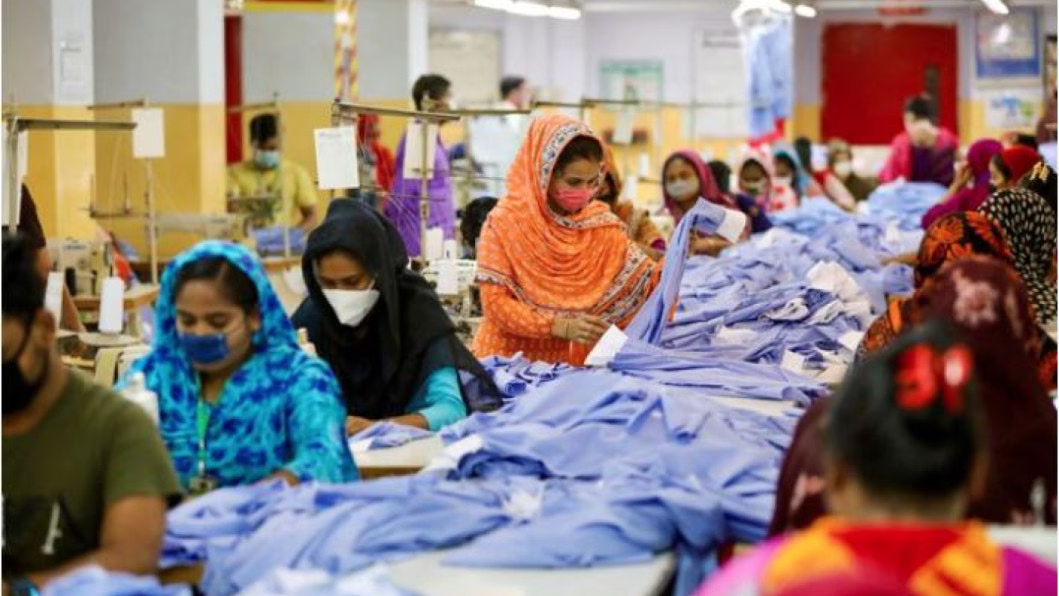
Garment exports to US rise 5% in July-October
Garment exports to the USA, the country’s largest single export destination, increased by 5.14 percent to $2.59 billion during July-October, despite facing a 20 percent reciprocal tariff imposed by the US under President Donald Trump’s administration.
The USA accounted for 19.92 percent of Bangladesh’s total garment exports during this period, according to data from the Export Promotion Bureau (EPB) compiled by the Bangladesh Garment Manufacturers and Exporters Association (BGMEA).
For all latest news, follow The Daily Star’s Google News channel.
Local exporters face a 35.5 percent duty on shipments to the USA, which includes the 20 percent reciprocal tariff and the previous 15.5 percent Most Favoured Nation (MFN) tariff.
Bangladesh’s 20 percent reciprocal tariff rate gave local exporters a competitive advantage over other garment-exporting nations, which face slightly higher tariffs.
Ramzul Seraj, managing director of Elite Group, said that although his company’s shipments to the USA were slow in August and October, the inflow of work orders from US-bound retailers and brands started increasing in November.
“The uncertainty is over now, as the tariff rate for Bangladesh is fixed lower compared with a few other countries. I hope the inflow of work orders from US buyers will also increase in the near future,” Seraj told The Daily Star over the phone.
Former BGMEA president Anwar-Ul-Alam Chowdhury (Parvez) said exports picked up slightly in October as US buyers received previously held-up work orders from Bangladesh due to reciprocal tariff negotiations.
He added that exports of garments to the USA depend on many factors, as sales of garment items to the US have also declined slightly.
Moreover, the lowering of tariffs by the Trump administration on Malaysia, Thailand, and Cambodia could affect Bangladesh’s shipments to the American market in the near future.
Apart from the USA, the European Union (EU) remains Bangladesh’s largest export destination for RMG, accounting for 48.17 percent of total exports in this category. Export earnings from the EU stood at $6.26 billion, registering year-on-year growth of 0.46 percent.
Exports to Canada and the United Kingdom also showed positive momentum. Exports to Canada reached $442.27 million, up 10.84 percent year-on-year, giving the country a 3.4 percent share of Bangladeshi garment exports.
Apparel exports to the UK were $1.53 billion, growing 2.72 percent year-on-year, with an 11.81 percent share.
While traditional markets maintained stable demand, RMG exports to non-traditional (emerging) markets fell by 2.69 percent during the period.
The knitwear segment grew modestly by 0.42 percent, showing stable performance, while the woven segment performed better with a 2.66 percent increase in exports.
Overall, RMG exports from Bangladesh reached $12.99 billion from July to October of FY 2025-26, up 1.40 percent compared to the same period of the previous fiscal year.




কারওয়ান বাজার, উপদেষ্টা রিজওয়ানার বাসা ও এনসিপি কার্যালয়ের কাছে ককটেল বিস্ফোরণ
এতে কেউ হতাহত হননি।
১ ঘণ্টা আগে
ভেনেজুয়েলায় যুদ্ধে জড়াচ্ছেন ‘শান্তিদূত’ ট্রাম্প?
১ ঘণ্টা আগে
Business
Star Business Report
Sun Nov 16, 2025 10:20 PM
Last update on: Sun Nov 16, 2025 10:20 PM


Most Viewed
- Everyone deserves a second chance, but not for perceived ‘merit’
- Crude bombs blasted in parts of Dhaka including Airport Railway Station
- With bad loans at 30%, boardroom feud erupts at Standard Bank
- Bangladesh Railway’s service woes persist
Sammilito Islami Bank may onboard foreign investors
Governor says
The Bangladesh Bank (BB) wants to bring in strategic foreign investors for the new shariah-based Sammilito Islami Bank, which is being created through the merger of five troubled Islamic lenders, according to BB Governor Ahsan H Mansur.
Days after the central bank gave the preliminary approval for the new bank, the governor said today that the process is underway.
For all latest news, follow The Daily Star’s Google News channel.
At the inauguration of the Bangladesh Islamic Finance Summit 2025 at Sheraton Dhaka, he said the new bank will be strong after a fresh public fund injection. It will begin the journey as a publicly owned institution.
“We would like to be handing over to strategic international investors as well as an eventual IPO [initial public offering],” he said in his speech as the chief guest. “That process is on.”
Mansur said he expects Sammilito Islami Bank to become the strongest in terms of financial position. It will start with the highest level of capital in the sector, with paid-up capital of Tk 35,000 crore.
He hoped it could turn a profit even in its first year because of the large injection of liquidity.
A week earlier, the central bank sent letters to First Security Islami Bank, Union Bank, Global Islami Bank, Social Islami Bank and Exim Bank, informing them of the decision to merge the five commercial lenders under the Bank Resolution Ordinance 2025.
Administrators have already been appointed to carry out the process, after which the merged entity will operate as Sammilito Islami Bank.
During the process, the BB said the shareholders of the five lenders would receive nothing because the net asset value of those banks was already negative.
On fund injection, Mansur said Islamic banking had been the biggest casualty of plundering in the banking system over the past 15 years. The government, therefore, had to step in to protect the lenders.
He said that if governance improves, depositors will respond positively and stay with the bank, just as depositors of Islami Bank Bangladesh have done. “Let it grow.”
The governor said Islamic banking in Bangladesh had been substantially damaged, although it remained resilient and would prove that resilience in the coming years.
He urged the sector to follow global best practices and maintain transparency to help Islamic finance contribute to economic growth and social justice.
He said the sector needs to think beyond crore banking businesses alone and include Islamic insurance, non-bank Islamic financing and digital banking in its vision for the future.
At the event, Mesbaul Asif Siddiqui, deputy managing director of City Bank, said sharia banking is an interest-free, value-based system and any compromise in these principles could cause serious harm.
He said the 1980s saw the rise of Islamic banking in Bangladesh, while recent years had seen a decline. The main cause was what he said, “a compromise of values”
Siddiqui said global Islamic finance assets stand at $4 trillion across 80 countries. Sukuk, capital markets and asset management are key pillars of the industry.
In Bangladesh, he said, bond and capital markets remain small and underdeveloped.
Senior officials from Islamic financial institutions and members of shariah boards spoke on the first day of the summit.
They said Bangladesh has many scholars capable of contributing to Islamic finance and urged them to place greater focus on the field.

Related Posts

Only football on our mind’: India players assured with Dhaka security
